Vísperas
La piel del tamborVísperas is the anonymous hacker who penetrates the Vatican’s computer network to carry an appeal from Seville to the Pope, making the endangered Nuestra Señora de las Lágrimas impossible for the Church’s central authorities to ignore. The identity behind the name is Cruz Bruner, an almost seventy-year-old woman whose clandestine digital practice links the church’s local struggle to an international network of computer enthusiasts. Her intrusion is both technically deliberate and politically pointed: she seeks a route to Rome because the ordinary channels have failed to make the parish’s plight heard.
The Name and the Intrusion
The name Vísperas began as a practical label. A Vatican technician, Father Cooey, explained that intruders were routinely given names for identification and tracking, often names already familiar to investigators. He called this one Vísperas because of the hour at which the activity first appeared on the screen. The name attached to the case before anyone knew the person behind it, turning an individual into a trace to be monitored.
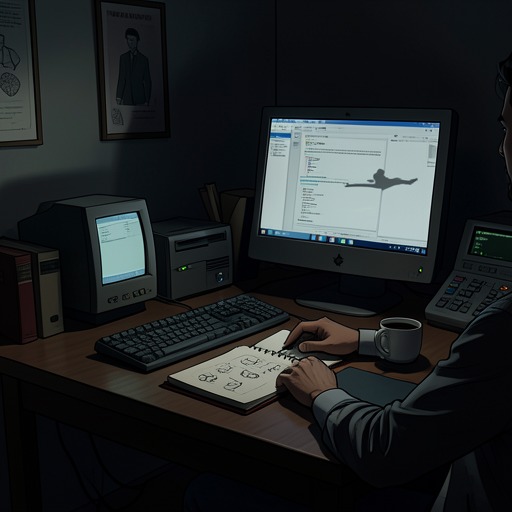
The intruder was already inside the Vatican network when Cooey examined the activity. At first Vísperas moved through its different entry points, then entered a system whose route appeared to be known from an earlier visit. The cursor reached INMAVAT, a restricted system holding access records for eighty-four cardinals and senior officials, and stopped at the line marked VOIA, the terminal associated with the Pope. A rising transfer record showed that the hacker had broken the security key and was introducing an unauthorized file.
Vísperas’s technical ability draws admiration even from the people trying to catch her. Cooey watches the rapid search through the restricted list and admits that the hacker is exceptionally good; Father Arregui, though angered by the intrusion and kept from sleep by it, feels the professional excitement of seeing a clandestine operator work. The scene presents hacking not as mysterious omnipotence but as skilled navigation of systems, access points, and defenses.
A Message for the Pope
The message Vísperas leaves appeals directly to the Pope as pastor and father. It argues that the papal office can be too distant for humble voices to reach, then identifies a church in Seville where merchants threaten the house of God. It describes the seventeenth-century church as abandoned by both ecclesiastical and secular power and says that it kills to defend itself. The appeal asks the Pope to look toward the least powerful members of his flock and demand an account from those who have left them to their fate.
The message appears on the Pope’s personal computer without a signature. Investigators determine that it was written in Seville on a computer connected to the telephone network, though its author has taken steps to disguise the precise point of origin. The disguise protects the sender while the message’s destination makes its purpose unmistakable: the appeal is meant to bypass the local institutions that have not responded and place the church’s situation before the highest authority.
That route has a technical history. Cruz later explains that she had a contact in Rome, Deus ex Machina, whom she suspected to be a young seminarian or priest. He had wandered through the Vatican system out of curiosity, and the two became sympathetic to one another. Six or seven months before the disclosure, when the problem of Nuestra Señora de las Lágrimas had become more acute, he gave her useful leads. Cruz first considered leaving a simple message in the Vatican’s central system. As she learned more about the network, she decided to reach the Pope’s computer instead.
Learning the Network
Cruz did not begin as a computer expert. At nearly seventy, she entered the digital world through a friend she knew only by the online handle Mad Mike, who sometimes operated as Viscount Valmont. His computer had a pirate BBS, or bulletin-board system, through which Cruz met other enthusiasts of high technology, often young people spending long hours alone with computers. She describes the world as something she explored under the guidance of a correspondent whose voice and face she would never know.
The network offered Cruz both access and anonymity. Its participants exchanged information across distance without needing to meet, while assumed names allowed a person to act beyond the social identity visible in ordinary life. The novel’s account of this community emphasizes its human connections as well as its technical tools: Cruz learns through contacts, clues, and the accumulated expertise of other users, rather than by conjuring access through an unexplained gift.
After discovering INMAVAT, Cruz recognized that the protected file must contain something important. She made trial attempts to enter it and drew on the tricks of more experienced friends. She then spent a week visiting the system before understanding what it contained. Her account makes the intrusion a process of observation and learning as well as a decisive breach: access opens the way, but repeated exploration reveals why the system matters and how it can be used to make the church’s appeal heard.
The Vatican’s countermeasures show how closely that access is contested. Investigators set up what their team calls Sadducean Traps: deceptive computer areas designed to lure intruders into confusing routes or expose identifying information. The trap prepared for the attempt on the Pope’s terminal used an invisible marker carried into INMAVAT by an external intruder. When Vísperas reached VOIA, the marker was supposed to block the real destination and redirect the hacker to a fictitious terminal, VOIATS, where any deposited message would do no damage. The supposed success of the intrusion and the institution’s effort to contain it thus occupy the same technical space.
The attempt to trace Vísperas is further complicated by concealment across telephone networks. According to the police contact Simeón Navajo, hackers commonly move through the internet and use loops or programs that erase their tracks and confuse detection systems. The equipment checks he conducts find no advanced computer hardware bought under the names and tax numbers on Quart’s list; that failure does not identify the hacker, but it underscores the difficulty of following a networked identity through ordinary records.
Cruz Bruner Revealed
Vísperas’s anonymity lasts until Cruz tells Lorenzo Quart how she entered the Vatican system and why. Her account establishes that she acted without consulting either the parish priest Príamo Ferro or her daughter Macarena Bruner. Macarena learned of the person called Vísperas only later, after the existence of the hacker became known. The separation between Cruz’s private digital undertaking and the people whose cause it serves is part of the revelation: she chose the method herself, even while acting on behalf of a community.
Cruz’s motive is bound to the church’s isolation. She says that neither the Archbishopric of Seville nor the Nunciature in Madrid had listened to Father Ferro, and she saw a way to make Rome hear him. Her intervention responds to the distance between a local parish and institutions powerful enough to decide its future. The name Vísperas therefore conceals not merely the hacker’s age and social identity but the personal origin of a political act: an elderly woman learns a new technical language and uses it to interrupt a chain of unanswered appeals.
The alias also becomes an interpretive mirror for Quart. During their conversation, Macarena wonders whether she might be Quart’s Vísperas, trying to draw him toward her cause or perhaps inflict another injury on Pencho Gavira’s honor. Quart recognizes the analogy without reducing Vísperas to a single motive. Later, speaking with Ferro, he says the hacker may be any one of them, all of them, or none of them; the identity does not alter the underlying situation. The remark separates the mystery of the operator from the realities that prompted the intervention.
Discovery and Its Limits
When the truth is known, Quart’s investigation has reached a point at which the hacker is no longer its most consequential subject. He understands more than he wants to know, yet the official report expected by the Institute for External Works cannot encompass the lives sheltered within Nuestra Señora de las Lágrimas. Rome wants the identity of the intruder and the possibility of scandal around the parish. Against those bureaucratic terms, Vísperas’s message has succeeded in drawing attention to a threatened church but has not made its human history legible to the institutions receiving the report.
Quart tells Ferro that he will report the two deaths as unfortunate accidents, in agreement with the police account, and describe the priest as waging a private war with the support of several parishioners. Without the computer intrusion and the memorandum to the Pope, he says, the matter would not have gone beyond the ordinary jurisdiction of Seville. The statement clarifies both the reach and the limit of Vísperas’s intervention: the breach has carried the affair to Rome, but the resulting official narrative can still reduce its people and conflicts to a manageable account.
When Quart meets Archbishop Corvo, he insists that identifying Vísperas is not the central issue. The hacker is an anecdote, he argues, and the identity will eventually be discovered; what matters is the situation of Ferro and Nuestra Señora de las Lágrimas. His report, he says, will allow decisions to be made with knowledge of the circumstances. The name that once fixed the authorities’ attention on an intruder thus becomes secondary to the church and community for which the intruder acted.
The final disclosure gives the alias a human face without turning it into a simple solution. Cruz’s access to a pirate BBS, her exchanges with unknown contacts, the clues from Deus ex Machina, and her week of exploration inside INMAVAT explain how she could carry out the intrusion. Her appeal explains why she chose to do it. Yet the official interest in Vísperas remains narrower than the cause the hacker wanted to advance: the network can cross a boundary that local petitioners cannot, but it cannot compel powerful institutions to value every life and memory behind the message.